back to Articles
Why Nigerian Businesses Outgrow Their Own Systems
Nwosu Chinenye
Marketing Intern
A business can grow faster than its ability to manage that growth.
It can have more customers, higher revenue, stronger demand and a larger team and still become less organized, less predictable and harder to run.
This happens because the systems that help a business start are not always the systems that can help it scale.
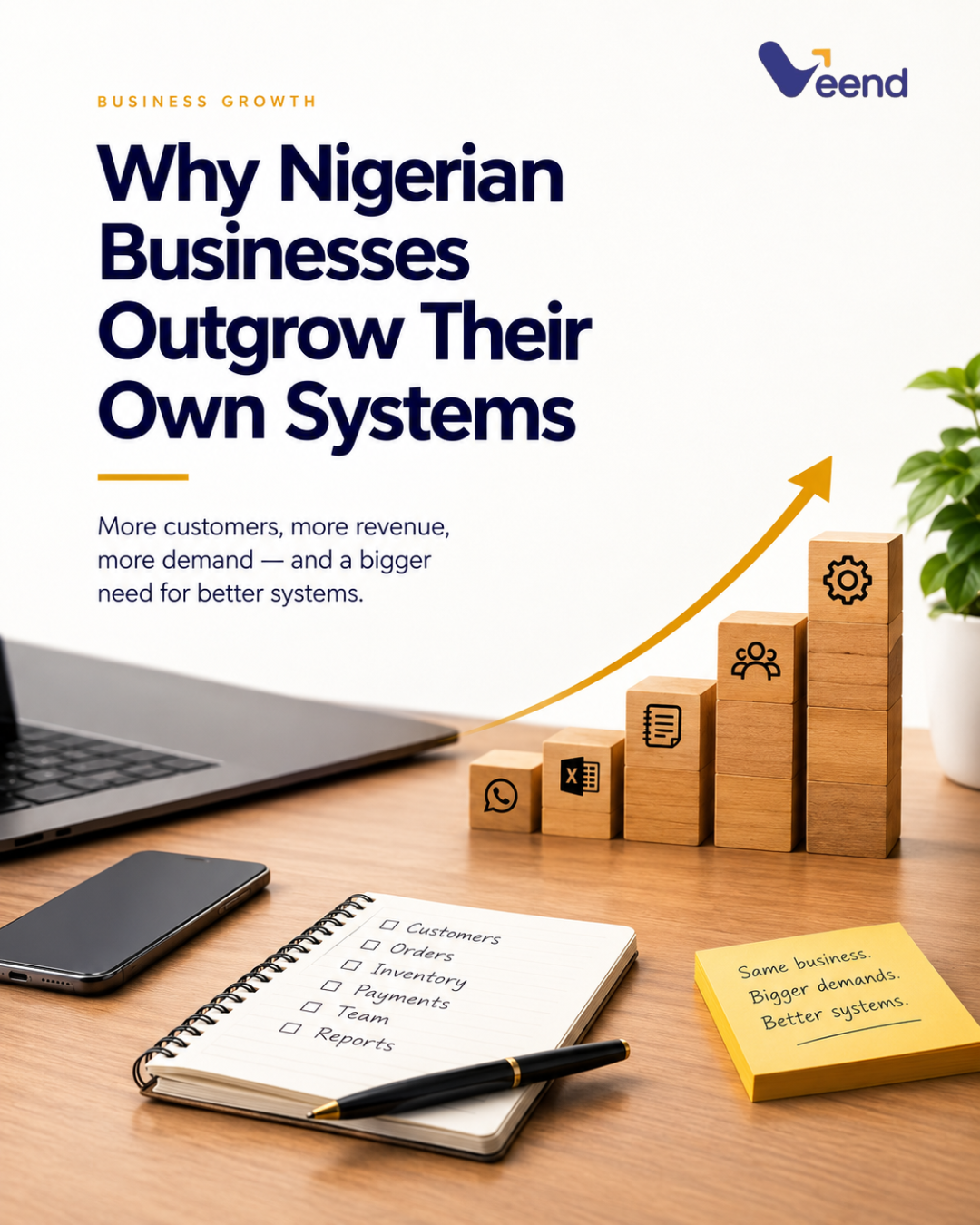
A founder may begin with a WhatsApp account, an Excel sheet, a notebook and a good memory.
At ₦1 million in monthly sales, that may be enough.
At ₦20 million, the same setup can become a liability.
Orders start getting missed. Stock numbers stop matching. Customer requests get buried in chats. Staff ask the founder questions they should already be able to answer. Reconciliation becomes a recurring headache. Reports take too long to produce.
Nothing about the business necessarily went wrong.
The business simply became bigger than its systems.
Growth creates a different kind of problem
When a business is small, a surprising amount of complexity can be absorbed by one person.
The founder knows which customer has paid.
They remember which supplier is waiting.
They know which product is almost out of stock.
They know which employee handles which task.
They can scroll through WhatsApp to find an old conversation.
They can call someone when a number does not look right.
The business may not have formal processes, but the founder's memory fills the gaps.
Then the business grows.
There are more customers.
More transactions.
More suppliers.
More employees.
More products.
More locations.
More decisions.
And suddenly, the business is asking human memory to function like infrastructure.
That is where problems begin.
The hidden cost of informal systems
The problem with informal systems is not that they are inherently bad.
In fact, they are often exactly what a new business needs.
A founder should not need an enterprise resource planning system to sell their first hundred products.
A small retailer can start by tracking sales on a spreadsheet.
A service business can manage early customers through WhatsApp.
A founder can approve expenses personally.
These methods are fast, cheap and flexible.
The problem comes when they remain unchanged while everything around them changes.
A spreadsheet that tracks 50 transactions may become difficult to manage at 5,000.
A WhatsApp inbox that once contained 20 customer conversations can become impossible to monitor when hundreds of customers are asking questions simultaneously.
A founder who personally approves every decision may initially provide control.
At scale, that same behaviour can become a bottleneck.
The system has not necessarily become worse.
The demands placed on it have become greater.
Revenue does not tell the whole story
Businesses often measure growth through numbers such as revenue, customer count, transaction volume or headcount.
Those numbers matter.
But there is another form of growth that receives less attention:
operational complexity.
Imagine a business growing from 10 customers to 1,000.
Revenue may increase tenfold.
But the number of interactions required to serve those customers does not necessarily increase in the same simple proportion.
There are more orders to process.
More payments to reconcile.
More customer questions.
More inventory movements.
More exceptions.
More employees.
More approvals.
More records.
More opportunities for information to become inconsistent.
Growth creates more relationships between things.
And those relationships need to be managed.
That is why a business can feel completely different at ₦20 million in monthly sales than it did at ₦2 million, even if it sells exactly the same product.
The founder becomes the system
One of the clearest signs that a business has outgrown its systems is when the founder becomes the operating system.
Everyone knows who to ask.
“Ask the CEO.”
“Check with her.”
“He knows the supplier.”
“She has the customer's number.”
“Only he can approve it.”
“Let's wait until she gets back.”
This can feel like control.
But it is actually concentration of information.
And concentrated information creates fragility.
If too many routine decisions depend on one person, that person eventually becomes the bottleneck through which the entire business must pass.
The founder cannot be everywhere.
They cannot remember every transaction.
They cannot monitor every customer.
They cannot reconcile every payment.
And they certainly cannot remain the only person who knows how everything works.
A scalable business gradually moves knowledge out of people's heads and into processes, records and systems.
That is not bureaucracy.
It is capacity.
The spreadsheet is not the problem
There is a tendency to frame this conversation as technology versus manual processes.
That misses the point.
A spreadsheet is not bad.
A notebook is not bad.
WhatsApp is not bad.
Manual processes are not automatically inefficient.
The real question is:
Does the system still give the business enough visibility and control for the complexity it now handles?
A spreadsheet may be perfectly adequate for one part of the business.
WhatsApp may remain the best way to communicate with certain customers.
Manual review may still be necessary for important decisions.
The problem arises when tools built for convenience become the foundation for processes that require reliability, traceability and coordination.
At that point, the business needs to redesign the way information moves.
Growth exposes invisible problems
Small businesses can hide operational problems surprisingly well.
Not because the problems do not exist, but because there are fewer moving parts.
If one employee makes a mistake, the founder may notice immediately.
If ₦50,000 is missing from a reconciliation, someone can probably trace it manually.
If a customer has a problem, the founder can intervene personally.
But as volume increases, small weaknesses multiply.
One missed order becomes ten.
One incorrect stock entry becomes a persistent inventory discrepancy.
One undocumented process becomes a problem whenever the responsible employee is absent.
One delayed report becomes a management decision made without current information.
The issue is not any individual mistake.
It is that the business has no reliable mechanism for preventing, detecting or correcting the mistake at scale.
Growth turns small operational weaknesses into structural ones.
The real transition is from memory to infrastructure
There is a stage in every growing business where the question changes.
At first, the question is:
“How do we get this done?”
Later, it becomes:
“How do we make sure this gets done correctly every time?”
Those are different questions.
The first is about effort.
The second is about systems.
A founder can remember to follow up with a customer.
A process can make a follow-up routine.
A manager can check stock manually.
A system can create a reliable record of inventory movements.
An accountant can reconcile transactions at the end of the week.
A better process can make reconciliation continuous.
A founder can explain a process to every new employee.
Documentation can make that knowledge transferable.
This is the shift from people carrying the business to systems supporting the people running it.
What businesses actually need to systemise
Not everything needs a sophisticated platform.
But growing businesses should pay attention to the activities where mistakes, delays or missing information become expensive.
That usually includes:
- Sales and order management: What was ordered, by whom and when?
- Inventory: What came in, what went out and what is actually available?
- Payments and reconciliation: What has been paid, what is outstanding and where did the money go?
- Customer information: What does the business know about each customer and where is that information stored?
- Approvals: Who can make which decisions without waiting for the founder?
- Reporting: Can management see what is happening without spending two days assembling numbers?
- Documentation: Can someone new understand how a process works without asking the person who created it?
- Performance tracking: Can the business identify what is working, what is slowing it down and where losses are occurring?
The objective is not to automate everything.
It is to make the important things visible, repeatable and controllable.
There is a cost to waiting
Businesses often invest in systems after a problem becomes painful.
The inventory discrepancy becomes large.
The accounting becomes messy.
A key employee leaves and takes critical knowledge with them.
Customer complaints increase.
The founder becomes overwhelmed.
Only then does the business decide it needs better processes.
But systems are easier to build before chaos becomes embedded.
The right time to document a process is before the person who knows it leaves.
The right time to improve reconciliation is before discrepancies become difficult to trace.
The right time to establish clear approval structures is before every decision starts landing on the founder's desk.
The right time to improve operational visibility is before management starts making decisions with incomplete information.
The next stage of growth requires a different business
This is the part many businesses underestimate.
Scaling is not simply doing more of the same thing.
A business serving 100 customers and a business serving 10,000 customers may sell the same product, but they cannot necessarily operate in the same way.
The second business needs a different level of coordination.
It needs clearer ownership.
Better information.
Repeatable processes.
Reliable records.
Defined decision rights.
And systems that can handle volume without requiring proportionally more human effort.
That is why some businesses seem to hit an invisible ceiling.
Demand is not necessarily the problem.
The market may not be the problem.
Even capital may not be the immediate problem.
Sometimes the business has simply reached the point where its operating model cannot comfortably support its own size.
Systems are not about becoming more corporate
There is another misconception worth challenging.
Building systems does not mean turning a business into a slow, bureaucratic organisation.
Done badly, it can.
Done well, systems should make the business lighter.
Employees should spend less time searching for information.
Managers should spend less time chasing updates.
Founders should spend less time answering routine questions.
Finance teams should spend less time reconciling information from multiple sources.
Customers should receive more consistent service.
The purpose of a system is not to create more work.
It is to reduce the amount of work required to maintain control.
That distinction matters.
A useful question for every growing business
Instead of asking only:
“How much have we grown?”
business owners should occasionally ask:
“What has become harder to manage because we have grown?”
The answer can reveal where the next investment needs to go.
Maybe it is inventory.
Maybe it is customer management.
Maybe it is financial reporting.
Maybe it is staff accountability.
Maybe it is internal communication.
Maybe it is simply documenting how things are done.
The answer will be different for every business.
But the underlying principle is the same.
Growth increases complexity.
And complexity eventually demands structure.
The businesses that scale are not necessarily the ones with the most technology
They are the ones that recognise when yesterday's way of working is no longer sufficient for today's reality.
They know when the spreadsheet has become too important to remain a spreadsheet.
When the founder's memory has become too critical to remain undocumented.
When WhatsApp has become too central to remain the only record.
When a manual process has become too important to depend on one person.
And when more customers require more than simply more people.
The goal is not to build a complicated business.
It is to build a business that can handle its own success.
Because the real test of growth is not whether a business can generate more demand.
It is whether the business has built enough structure to absorb that demand without losing control.
That is the point at which growth stops being something the founder is personally holding together and starts becoming something the business itself can sustain.