back to Articles
The VIDA Recovery Intelligence Stack: A Smarter Framework for Loan Recovery in Nigeria
Nwosu Chinenye
Marketing Intern
When thousands of borrowers are overdue, the challenge is not contacting everyone. It is knowing what to do next.
Nigeria's credit market is expanding, but lenders continue to face a fundamental challenge: how to grow lending while effectively managing repayment risk.
Private-sector credit grew by about 20% in 2025, according to the International Monetary Fund, while credit remained relatively shallow at around 12% of GDP. At the same time, the Central Bank of Nigeria estimated the banking sector's non-performing loan ratio at 7.0% at the end of 2025, above the regulatory prudential benchmark of 5%.
The implication is clear: Nigeria needs more credit, but sustainable credit growth requires more than better origination and faster disbursement. It requires lenders to become significantly better at managing the entire credit lifecycle, particularly what happens after disbursement.
Because lending does not end when money leaves the lender's account. It continues through repayment, and when repayment becomes uncertain, lenders need more than a collections queue.
They need intelligence.
At VeendHQ, we see this as a shift from collections activity to recovery intelligence, which can be understood through a simple framework:
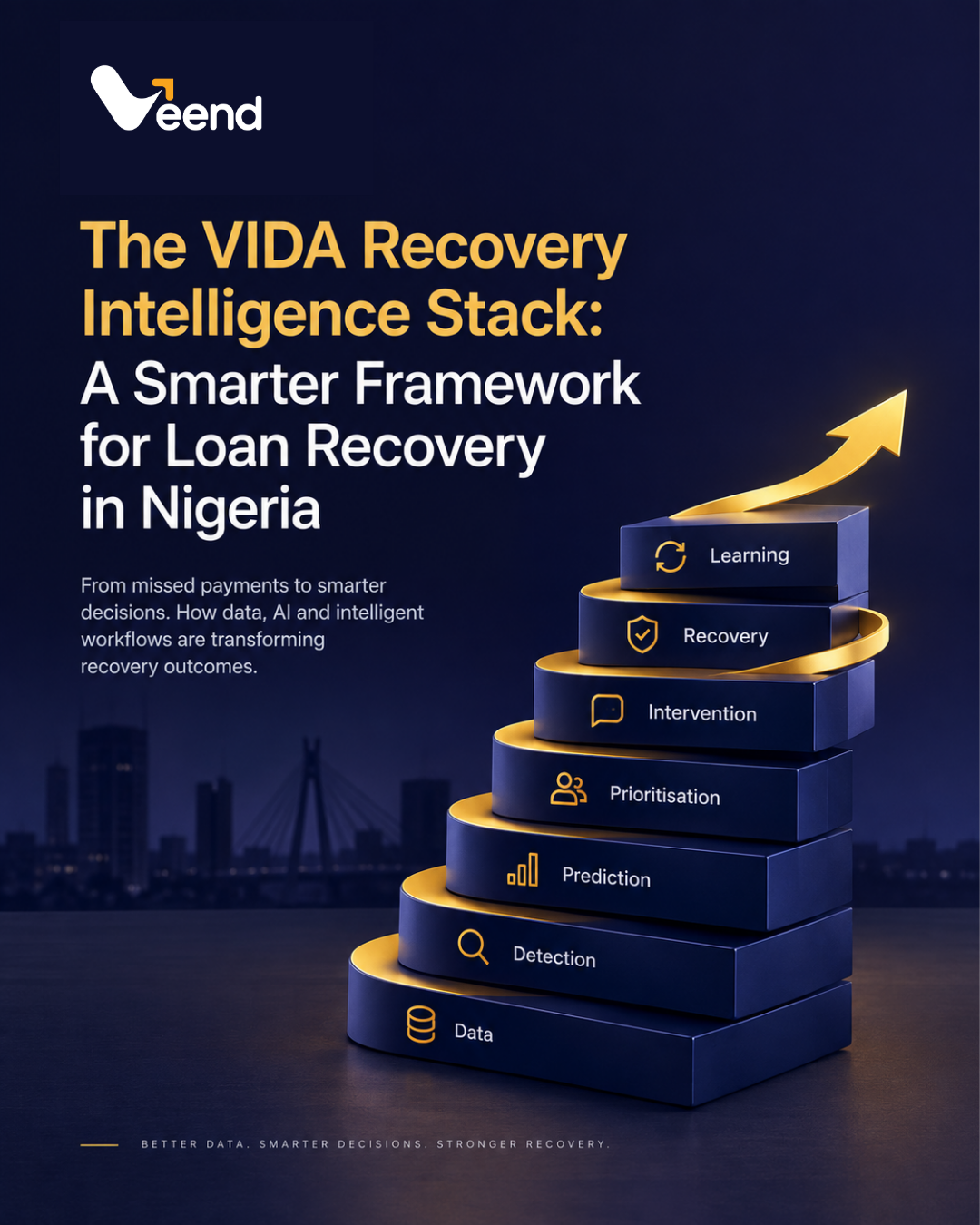
Data → Detection → Prediction → Prioritization → Intervention → Recovery → Learning
We call this VIDA Recovery.
Why Recovery Needs a New Approach
Traditional recovery often follows a familiar pattern:
Missed payment → Reminder → Phone call → Follow-up → Escalation → Recovery attempt
This can work when portfolios are small and borrower situations are relatively straightforward.
But consider a lender with 10,000 overdue accounts.
Should all 10,000 borrowers receive the same message? Should all be called? Should every account be escalated?
Clearly not.
One borrower may have missed a payment because of a temporary cash-flow disruption and may repay after a simple reminder. Another may have a history of repeated late payments and ignored interventions. Another may be eligible for restructuring, while another may have the capacity to pay but consistently avoids repayment.
They are all overdue, but they are not the same recovery problem.
The challenge is therefore not simply:
"Who is overdue?"
It is:
"What is the most appropriate next action for each account?"
That is where recovery intelligence becomes important.
Introducing the VIDA Recovery Intelligence Stack
The VIDA Recovery Intelligence Stack is a seven-stage framework for turning repayment and behavioral data into better recovery decisions. It moves recovery from a reactive process into a continuous decision-making system.
Data → Detection → Prediction → Prioritization → Intervention → Recovery → Learning
Each stage answers a different question.
1. Data: What Do We Know?
Every intelligent recovery system starts with reliable information.
This includes relevant repayment, behavioral and financial data collected within appropriate legal, regulatory and privacy boundaries.
A lender may need to understand:
- Repayment history
- Previous delinquencies
- Payment frequency
- Outstanding exposure
- Borrowing patterns
- Cash-flow behavior
- Previous recovery interactions
- Response to reminders
- Restructuring history
- Account activity
The goal is not to collect data simply because it exists. It is to build a useful picture of the account.
Nigeria's increasingly digital financial ecosystem makes this opportunity significant. NIBSS reported approximately 11.2 billion electronic payment transactions in 2024, with electronic payment value reaching about ₦1.07 quadrillion.
But more data does not automatically mean better decisions. Data needs to be accessible, reliable, appropriately governed and converted into usable intelligence.
Without good data, every stage that follows becomes weaker.
2. Detection: What Is Changing?
The next question is:
"Is something changing in this borrower's behavior?"
A borrower does not necessarily become risky on the day a repayment is missed. There may have been signals beforehand: changing repayment patterns, increased borrowing frequency, deteriorating cash-flow behavior, progressively later payments, or increased exposure while repayment capacity appears weaker.
Detection is about identifying meaningful changes early enough for the lender to respond.
Traditional recovery often begins when the problem becomes visible. Intelligent recovery looks for the signals that may indicate the problem is developing.
Detection moves the lender from seeing the outcome to recognizing the warning signs.
3. Prediction: What Is Likely to Happen Next?
Detection tells the lender what is changing. Prediction asks:
"What could happen next?"
Analytical and AI models can help lenders estimate which accounts are more likely to deteriorate, which borrowers are likely to respond to an intervention, and which accounts may require additional attention.
Consider two borrowers who have both missed a repayment.
Borrower A has historically paid every installment on time and has experienced a temporary cash-flow disruption.
Borrower B has repeatedly delayed payments, ignored previous interventions and increased borrowing.
Both are overdue, but their likely recovery journeys may be very different.
Prediction helps the lender recognize that difference.
Instead of asking only "Who has defaulted?", the lender can begin asking:
"Who is likely to recover, who is likely to deteriorate, and what could influence the outcome?"
Prediction turns recovery from hindsight into foresight.
4. Prioritization: Who Needs Attention First?
This may be the most important operational question in a large recovery portfolio.
If 10,000 customers are overdue and the lender has limited human resources, it cannot treat every account as equally urgent.
The lender needs to determine:
- Which accounts are most likely to deteriorate?
- Which accounts can potentially be resolved with low-cost interventions?
- Which accounts require human attention?
- Which accounts may benefit from restructuring?
- Which accounts require escalation?
- Where will additional recovery effort have the greatest impact?
Prioritization creates focus.
Instead of giving every overdue borrower the same treatment, the lender allocates resources according to the characteristics and likely needs of each account.
This can improve both recovery outcomes and operational efficiency.
The objective is not to work harder on every account.
It is to know where effort matters most.
5. Intervention: What Should We Do Next?
Once an account has been prioritized, the next question is:
"What is the right intervention?"
Not every borrower needs a phone call, an escalation or the same message.
Depending on the account, the appropriate action might be:
- A reminder — for a borrower who is likely to pay with a simple prompt.
- A payment prompt — where timing or convenience may be the main barrier.
- A repayment-plan conversation — where the borrower may need a more structured path to repayment.
- Restructuring — where circumstances suggest modifying the repayment arrangement may produce a better outcome.
- Human intervention — for complex, sensitive or higher-priority cases where context and judgement matter.
- Escalation — where previous interventions have failed and the account requires a different recovery approach.
This is where recovery becomes more than automation.
The objective is not maximum pressure. It is of maximum relevance.
The right intervention should reach the right borrower at the right time through the right channel.
6. Recovery: What Actually Happened?
An intervention is only useful if the lender measures its outcome.
Did the borrower respond? Did they make a payment? Did the intervention fail? Did they request restructuring? Was the account resolved? How much did the recovery effort cost, and how long did it take?
These questions turn recovery from an activity into a measurable process.
For example, if a simple reminder consistently resolves a particular segment of overdue accounts, there may be little value in immediately assigning those borrowers to expensive human-led collections.
Similarly, if repeated automated messages consistently fail for another segment, continuing the same intervention may simply increase cost without improving outcomes.
Recovery intelligence depends on measuring what happens after the decision.
7. Learning: What Did the Outcome Teach Us?
This is what makes the Recovery Intelligence Stack a continuous system rather than a one-way process.
Every recovery outcome creates new information.
A successful repayment, missed payment, successful restructuring or failed intervention tells the lender something. A borrower who responds immediately to a reminder provides a different signal from one who repeatedly ignores every intervention.
That information should not disappear once the account is resolved. It should feed back into the system.
The cycle becomes:
Data → Detection → Prediction → Prioritization → Intervention → Recovery → Learning → Data
And the process starts again.
This is the core of the Recovery Intelligence Stack.
From a Collections Queue to a Decision Engine
The difference between traditional collections and recovery intelligence becomes clearer when we return to the 10,000-overdue-account example.
A traditional system may produce a list:
10,000 overdue borrowers
A recovery intelligence system asks:
- Which borrowers are likely to pay after a reminder?
- Which accounts show signs of deteriorating repayment behavior?
- Which borrowers may need restructuring?
- Which accounts require immediate human attention?
- Which cases should be escalated?
- Which intervention has historically worked for similar borrowers?
The result is no longer simply a collections queue.
It becomes a decision engine.
That distinction matters because recovery teams have finite time, capacity and budgets. Intelligence helps determine where those resources should go.
Recovery Should Be Personalized, Not Aggressive
There is another important reason for making recovery more intelligent.
Better recovery should not mean more aggressive recovery.
Nigeria's digital lending market has faced increasing regulatory scrutiny around abusive recovery practices, data privacy, harassment and unfair treatment. The FCCPC's regulatory framework for digital and non-traditional consumer lending places emphasis on transparency, fairness, responsible conduct and data protection.
Technology should support those principles, not undermine them.
If a lender knows that one borrower needs a simple reminder while another requires a restructuring conversation, treating both with the same aggressive approach is not intelligent recovery.
It is an inefficient recovery.
The better question is:
"What intervention is most appropriate for this borrower and this situation?"
That creates room for technology and responsible lending to work together.
The Feedback Loop Between Recovery and Lending
Recovery intelligence should also improve future lending decisions.
Recovery data should not disappear after an account is resolved. It can become an input into future credit decisions.
Consider the complete cycle:
Underwriting → Lending → Repayment → Recovery → Learning → Better Underwriting
A successful repayment provides information about borrower behavior. So does a missed payment, a restructuring or a failed recovery attempt.
Over time, these outcomes can help lenders improve risk segmentation, repayment structures, loan limits and future credit decisions.
This turns recovery from the final stage of lending into part of the system that improves the next lending decision.
Why This Matters for Nigeria
Nigeria's credit infrastructure is becoming increasingly digital. Payments are growing, credit demand remains significant, financial institutions are generating more data, and regulatory expectations are becoming more sophisticated.
But the value of these developments depends partly on what lenders can do with the information available to them.
Interoperability, credit reporting, digital identity, open banking, data standards, consent mechanisms and secure data-sharing infrastructure all influence how effectively lenders can understand borrowers across the credit lifecycle.
The opportunity is therefore bigger than simply building faster loan origination systems.
Nigeria needs credit infrastructure that supports the entire journey:
Origination → Underwriting → Disbursement → Repayment → Recovery → Learning
VIDA Recovery intelligence belongs inside that infrastructure.
The VeendHQ View
At VeendHQ, we believe recovery should evolve from a function that reacts to overdue accounts into a system that continuously generates intelligence.
That means moving:
From reactive to predictive.
From volume to precision.
From generic interventions to personalized interventions.
From collections activity to recovery intelligence.
From recovery as an endpoint to recovery as a feedback loop.
The VIDA Recovery Intelligence Stack gives lenders a practical way to think about that transformation.
It is not simply about adding AI to collections. It is about connecting the entire decision-making process:
Data gives the system context.
Detection identifies what is changing.
Prediction estimates what may happen next.
Prioritization determines where attention matters most.
Intervention selects the appropriate response.
Recovery measures the outcome.
Learning turns that outcome into better future decisions.
Then the cycle begins again.