back to Articles
NPL Ratio in Nigeria: Why 4.3% and 8.03% Can't Be Compared
Nwosu Chinenye
Marketing Intern
NPL Ratio in Nigeria: Why 4.3% and 8.03% Can't Be Compared
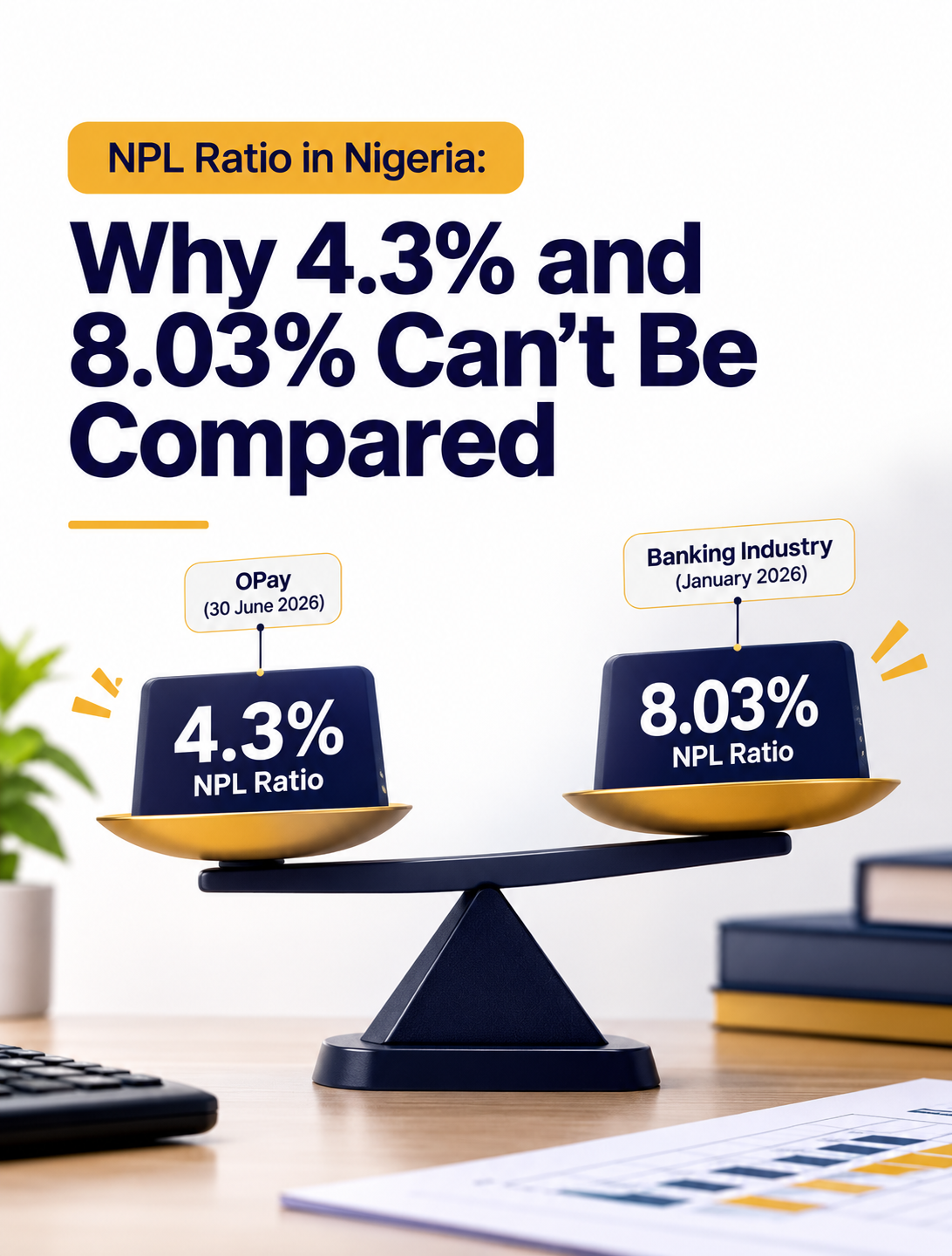
An NPL ratio only means something next to another lender if both count the same loans over the same period, and in Nigeria they often don't. OPay's SEC filing reports a 4.3% non-performing loan ratio at 30 June 2026. The banking industry stood at 8.03% in January. Read side by side, that looks like a 3.7-point lead. It isn't one, because the two numbers measure different books.
For a head of risk or collections, the filing is useful for a different reason: it shows which numbers to ask for when you want to know how a loan book is really performing.
What the filing says
According to TechCabal's reading of the registration statement, OPay classifies a loan as non-performing at 90 days past due and charges it off at 120 days. Coverage by Nairametrics adds the larger picture. New loans issued in Nigeria rose to $927.63 million in the first half of 2026, up from $305.12 million a year earlier. Expected credit loss expense rose 210.3% to $118.36 million. Borrowers were late on $113.80 million at 30 June, or 27.4% of the $415.33 million owed. And OPay wrote off $113.15 million of loans in the half-year, more than the $69.95 million it wrote off in all of 2025.
Put those together and "4.3%" becomes one number among four that describe the same book: 27.4% of the balance is late, 4.3% is 90 or more days late and still on the books, and a growing amount has already left the books through write-offs.
Why the ratios don't line up
The NPL ratio is non-performing loans divided by total loans. Two choices change it without any change in repayment behavior.
The first is when a loan counts as non-performing. The second, and bigger, is when a bad loan stops being counted at all. TechCabal points out that a lender writing off at 120 days removes loans that a bank charging off at 360 days would keep on its books for roughly eight more months, still counted in the ratio. OPay does not disclose what it charged off between those two thresholds, so no one outside the company can say what its ratio would be on a 360-day basis.
Here is an illustration, not real portfolio data. Two lenders each have ₦1 billion outstanding. In each book, ₦30 million is 90 to 120 days past due and ₦60 million is 120 to 360 days past due.
- Lender A writes off at 360 days. Its non-performing loans are ₦90 million on ₦1 billion: a 9.0% NPL ratio.
- Lender B writes off at 120 days. It removes the ₦60 million, leaving ₦30 million non-performing on ₦940 million: a 3.2% NPL ratio.
The borrowers behave identically. The ratios differ by nearly six points. Lender B has not collected a naira more than Lender A.
What to track alongside the NPL ratio
A single ratio cannot carry a portfolio review. These are better at telling you what is happening, and each can be compared across lenders once the definitions are stated.
Overdue share, by bucket. The share of the balance is 1 to 30, 31 to 60, 61 to 90 and 90+ days late. OPay's 27.4% is this kind of figure, and it shows stress long before the NPL line moves.
Roll rates. Of the loans in one bucket this month, what share moved to the next bucket the month after? A rising 31-to-60 roll rate is an early warning you can act on while the loan is still collectable.
Write-offs as a share of originations or of average book. If write-offs grow faster than disbursements, a low NPL ratio is partly a timing effect. OPay's write-offs rose 520.5% in the half-year while originations roughly tripled.
Cost of risk. Provisions divided by what you lend. TechCabal's headline framing was $1.28 of expected credit loss for every $10 lent in Nigeria, against $2.55 of loan revenue. Translated to naira terms, that is roughly ₦12,800 of expected loss against ₦25,500 of revenue for every ₦100,000 lent, so provisions consumed about half of loan revenue.
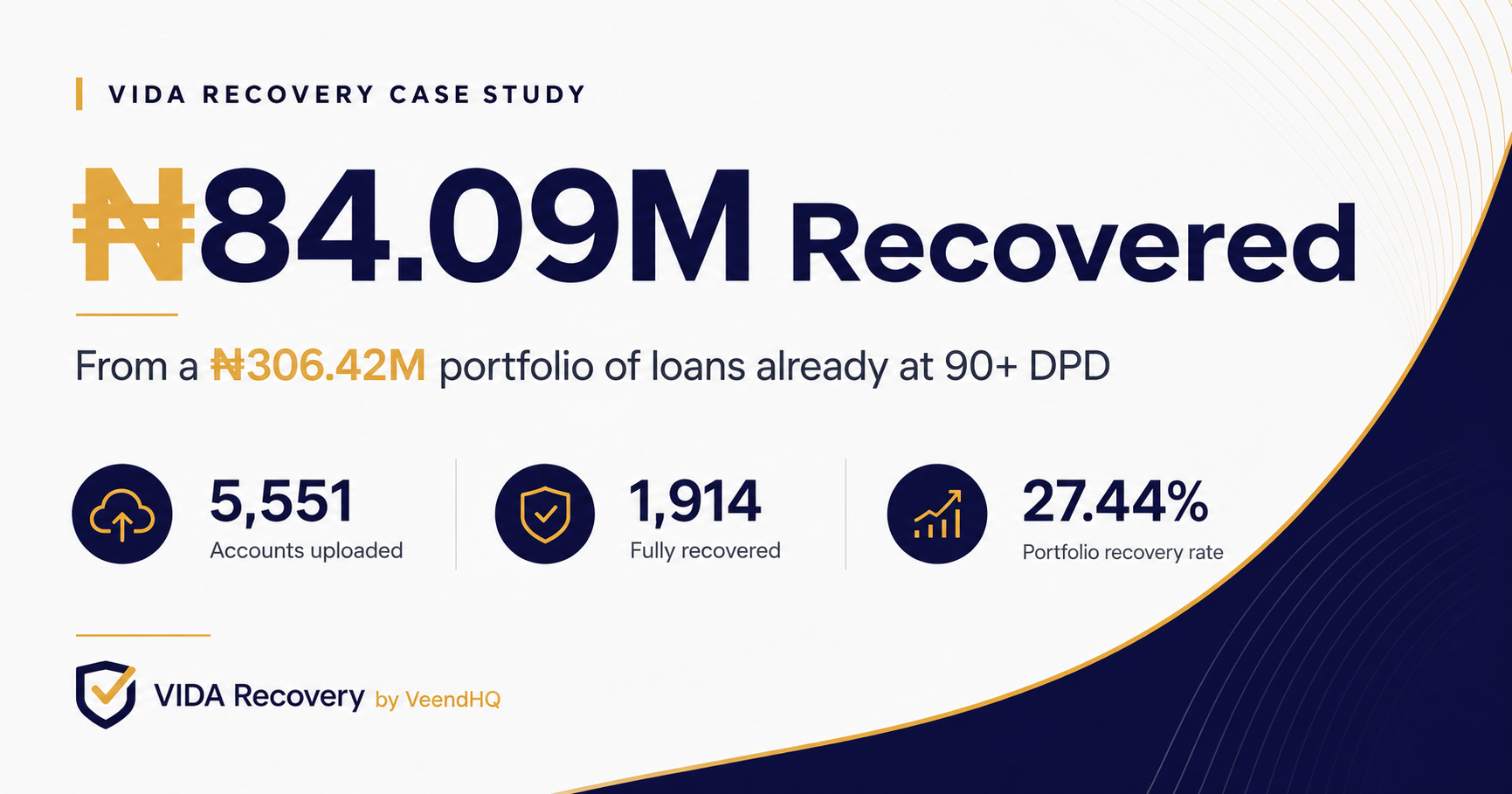
Recoveries after write-off. The filing states that recoveries on previously written-off loans reduce credit-loss expense. That makes post-write-off collections a line in the P&L, not an afterthought. For reference, a VIDA AI recovery pilot recovered ₦69 million of a ₦172.5 million overdue portfolio, a 40% recovery rate.
Questions to ask before comparing your book to anyone else's
- At what day count does a loan become non-performing, and at what day count does it leave the book?
- Is the ratio computed on gross loans or net of provisions?
- Are restructured loans counted, and for how long?
- What is the ratio on a fixed 360-day basis, so that it can be compared with banks?
If you cannot answer the fourth question for your own book, that is the first piece of work. The CBN reported the banking industry at 8.03% in January 2026, against a 5% prudential threshold, after forbearance ended and loans were reclassified. Lenders that report a much lower figure to investors, funders or partners should expect to be asked how it was computed.
For microfinance banks and digital lenders, classification and write-off rules depend on the regulator and auditors that apply to you, so check those directly rather than assuming the bank rules or another lender's policy apply.
What this means for a collections team
A short write-off clock changes what collections are for. If a loan leaves the book at 120 days, the collections window that protects your reported ratio is the 90 to 120 day stretch, and what happens after is recovery. Both matter, but they need different targets and different reporting, and mixing them hides which one is working.
If your team wants to see how that split looks in its own portfolio, book a VIDA demo.