back to Articles
Credit Risk Has Become a Network Problem
Pius Henry
Marketing Lead
Credit Risk Has Become a Network Problem
Why a borrower can look healthy in your system while deteriorating somewhere else
A borrower can be one of your best customers and still be a bad credit decision today.
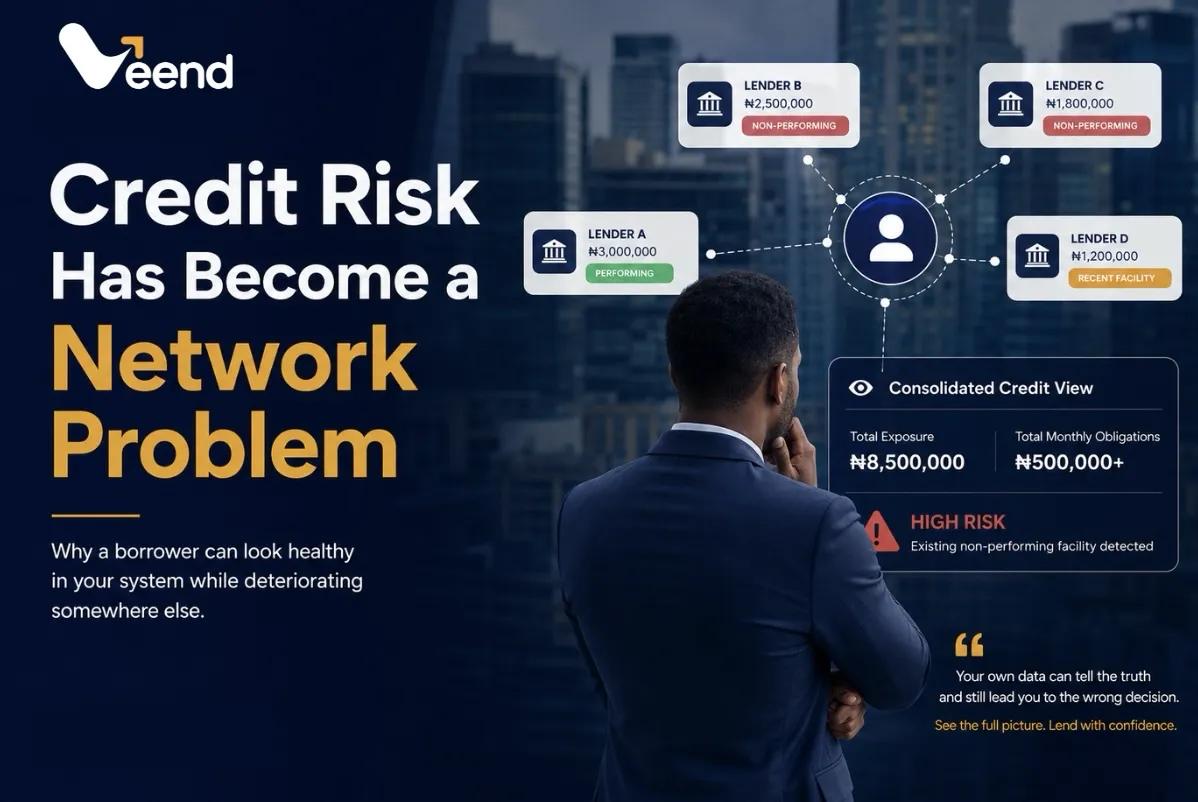
Imagine a customer who has taken four loans from the same lender and repaid every one on time. Their repayment history is clean. Their internal score is strong. They qualify for a higher limit, and nothing in the lender's own records suggests otherwise.
Now imagine that since their last loan, the same customer has taken on significant debt elsewhere. One facility is already non-performing. Another was opened recently. Their total monthly obligations have risen substantially.
Inside the first lender's system, this is still a good customer.
Across the credit system, it may be a very different borrower.
Nothing in the lender's data is necessarily wrong.
It is simply no longer enough.
That distinction sits at the heart of a recent Central Bank of Nigeria directive, and it raises a much bigger question about how lenders should think about creditworthiness.
A default somewhere else now matters here
On March 12, 2026, the CBN directed banks to deny additional credit to large-ticket obligors with non-performing facilities recorded in the Credit Risk Management System (CRMS) or a licensed private credit bureau.
The restriction goes beyond conventional loans. It covers facilities that could create additional exposure, including letters of credit, performance bonds and advance payment guarantees.
The directive is specifically aimed at large borrowers whose exposures could pose material risks to individual banks or the wider financial system. It also reinforces an earlier CBN circular that prohibited loan defaulters from further access to credit facilities in the banking system, so the regulator's direction of travel here is not new.
So this is not a blanket rule for every Nigerian borrower, and it should not be presented as one.
But the logic behind it extends well beyond large corporate credit:
A lender's experience with a borrower is not the same thing as the borrower's complete credit position.
The distinction sounds obvious.
In practice, it changes how credit should be assessed.
Performing with you does not mean performing everywhere
The CBN created the CRMS because Nigeria has dealt with this problem before.
In explaining the history of the system, the CBN describes borrowers who would leave unpaid obligations at one bank and obtain new facilities from another. Bilateral enquiries between banks were often slow, incomplete or unreliable, leaving institutions without a consolidated view of what borrowers already owed.
The result was predictable: lenders sometimes continued extending credit to customers who already had significant unserviced debts elsewhere.
One stated objective of the CRMS is particularly important. The CBN says consolidated information allows the regulator and banks to see a customer's global debt profile, helping to avoid situations where the same borrower is effectively treated as performing in one institution while being classified as doubtful or lost in another.
That is the real insight behind the current directive.
Credit performance can be local. Credit risk is not.
A facility may be performing.
The borrower may still be deteriorating.
And when lenders confuse those two things, good repayment history can create a false sense of security.
Your own data can tell the truth and still lead you to the wrong decision
Internal data is valuable.
A lender should know whether a customer pays on time, how frequently they borrow, how they use a product, whether their income into an account has changed and how they have behaved through previous credit cycles.
The problem begins when that information is treated as a complete picture of creditworthiness.
Because your system mostly sees what happens between the borrower and you.
It may not immediately tell you that the borrower has accumulated new obligations elsewhere.
It may not tell you that another facility has deteriorated.
It may not tell you that a customer who comfortably serviced ₦200,000 in monthly obligations six months ago is now carrying ₦500,000.
And crucially, your own repayment data may be one of the last places that deterioration becomes visible.
A borrower does not become risky on the day they first miss a payment to you.
Their financial position may have been weakening long before that.
This creates a dangerous lag in credit decisioning.
By the time the deterioration appears in your own repayment ledger, you may already have increased the customer's limit, issued a top-up or approved another facility based on a version of the borrower that no longer exists.
The risk can be highest when the lender feels most confident
This becomes particularly interesting with repeat borrowers.
A new customer naturally attracts scrutiny. The lender knows relatively little about them, so verification and underwriting tend to matter.
A customer who has successfully repaid several loans feels different. They have earned trust.
That trust has real value. Previous repayment behavior should absolutely influence future credit decisions.
But previous repayment should be evidence, not automatic permission to lend again.
Because something important can happen between Loan Four and Loan Five: the borrower can change.
Their income can change. Their obligations can change. Their business cash flow can change. Their exposure to other lenders can change.
Their previous loans tell you how they handled previous obligations. They do not, by themselves, tell you whether the borrower can absorb another obligation now.
That means one of the easiest lending decisions to automate, the repeat loan to a historically good customer, can also contain an overlooked risk: relationship confidence can outlive current creditworthiness.
The question is therefore not:
"Has this person been a good borrower?"
It is:
"Given everything we know today, are they still a good borrower for this amount?"
Those are not the same underwriting question.
In a stressed credit environment, that gap becomes more expensive
This problem matters even more when credit conditions are deteriorating.
S&P Global Ratings estimates that Nigerian banks' non-performing loan ratio rose from under 5% in 2024 to about 7% in 2025 following the end of regulatory forbearance on several large exposures, taking it above the 5% regulatory threshold. It expects NPLs to remain elevated at roughly 6% to 7% through 2026.
There is another important detail in S&P's assessment. It estimates that about half of Nigerian banks' gross loans are concentrated among their top 20 exposures, with considerable overlap in borrowers across the largest banks.
In other words, the same underlying borrower can matter to several institutions at once.
The cost of recognizing deteriorating credit risk late is also becoming clearer.
BusinessDay's review of the 2025 audited accounts of ten Nigerian banks found impairment charges rising 39%, from ₦2.3 trillion to ₦3.2 trillion, as previously restructured exposures were recognized more fully following the end of forbearance.
Not all of that loss is a data problem, of course. Businesses fail. Markets change. Macroeconomic shocks happen. Even excellent underwriting produces defaults.
But it reinforces an important principle:
When the cost of credit mistakes is rising, the cost of incomplete visibility rises with it.
Creditworthiness should be treated as a current state, not a permanent label
Lenders naturally classify customers.
Good borrower. High risk. Repeat customer. Prime. Subprime. Eligible. Ineligible.
Those classifications make credit systems scalable.
But they can also create the illusion that creditworthiness is a characteristic the customer possesses.
It isn't.
Creditworthiness is a state. And states change.
A borrower who was affordable six months ago may be stretched today.
A customer with no external debt at their last assessment may now have several obligations.
A business with healthy cash flow when its previous facility was granted may have experienced a material decline.
The practical consequence is important:
Every new credit decision is a new risk decision.
Historical performance should inform it. It should not replace it.
That is especially true when an existing borrower wants a materially larger facility, a top-up or another loan after their financial circumstances may have changed.
The best underwriting systems will increasingly need to answer two things simultaneously:
How has this customer behaved with us?
and
What does their wider financial position tell us now?
The first question creates relationship intelligence.
The second prevents relationship intelligence from becoming a blind spot.
This changes what "better underwriting" actually means
The answer is not simply to pull more reports or accumulate more data.
A lender can have a credit bureau report, transaction history, identity information, internal repayment data and an affordability model and still make a poor decision if those signals are treated independently or interpreted poorly.
The objective is not maximum data.
It is minimum blind spots at the moment a credit decision is made.
That requires a few changes in how lenders think about underwriting.
A previous good loan should strengthen a customer's case, but not eliminate the need to reassess current capacity.
A material increase in exposure should trigger a fresh view of the borrower's obligations, rather than relying entirely on the score generated during an earlier facility.
And when current external information conflicts with a historically strong internal profile, the conflict itself should become a risk signal worth investigating.
That is a fundamentally different way of thinking about credit.
The lender is no longer underwriting a relationship.
It is underwriting a borrower whose financial life extends beyond that relationship.
The next competitive advantage is seeing deterioration earlier
At VeendHQ, we believe this is where the credit infrastructure conversation needs to move.
Digitizing applications was important. Automating decisions was important. Making credit information accessible was important.
The next challenge is making those systems better at understanding what has changed.
Not simply:
Who is this borrower?
But:
What obligations exist today?
What has changed since the last decision?
Does current cash flow still support another facility?
Are external signals contradicting what internal history suggests?
Has a previously strong borrower started becoming a weaker risk before the weakness appears in our own book?
That is the difference between collecting credit data and turning credit data into decision intelligence.
And it matters because the goal of better credit infrastructure should not simply be to reject more risky borrowers.
It should also make lenders more confident about approving good ones.
The more accurately a lender can distinguish between a genuinely healthy repeat customer and one whose position has deteriorated elsewhere, the less it has to compensate for uncertainty with blunt limits, overly conservative policies or higher pricing for everyone.
That is ultimately what better visibility should achieve: not less lending, but better lending.
The CBN's March directive deals with Nigeria's largest problematic exposures. But the principle underneath it is much broader.
A borrower should not be able to appear healthy simply because risk is sitting somewhere the next lender cannot see.
And lenders should not assume that a good relationship tells them everything they need to know about the customer behind it.
Your customer can still be paying you and already be becoming a bad credit risk.
The lenders that recognize that early will have an advantage.
Because the next era of credit will not be won by whoever knows their customers best.
It will be won by lenders that can understand when those customers have changed.